

 Australia
 USA
USA UK
UK Ireland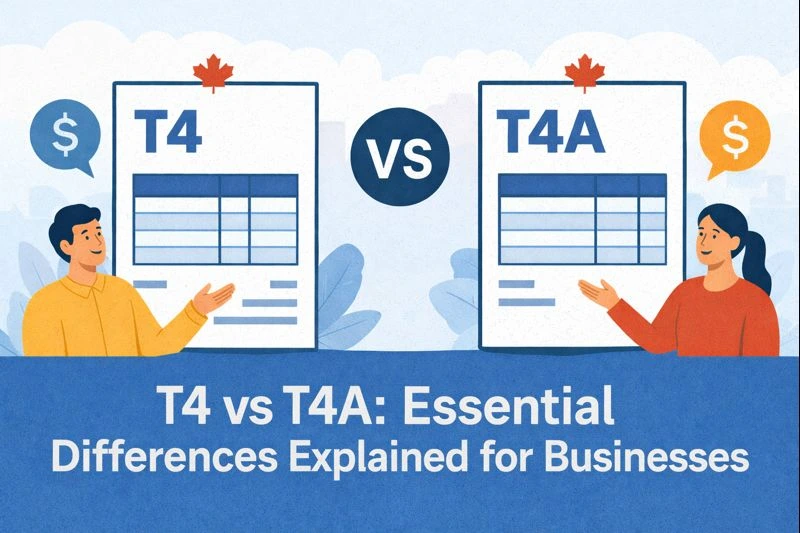




As a business owner in Canada, whether you run a small start-up or a growing company facing challenges in T4 vs T4A tax slips, navigating the challenges can be difficult. The majority of employers know how to do payroll: pay workers, pay taxes, and maintain records. However, when tax time arrives, there is one question that causes more confusion than anything: Do I issue a T4 or a T4A?
These forms appear similar to each other. They both report income, are submitted to the CRA, and dictate how your worker will file their taxes. Yet the difference between a T4 slip and a T4A slip is by no means a mere technical issue, but it has a direct impact on your tax outsourcing services, on the filing of your workers, and on your risk of being punished by CRA.
Think of hiring two different professionals. A T4 is like hiring a full-time employee; it is all regulated, planned, and obligatory. A T4A is comparable to hiring a freelance expert: more flexible, project-oriented, and with different tax accounting. The combination of these two types of employees can result in inaccurate deductions and misclassification, as well as possible CRA audits (it can spoil your week or month).
This blog simplifies the difference between T4 vs T4A in an easy-to-understand, real-life, employer-friendly manner. If you need to hire your first employee or operate with dozens of contractors, you will know what to issue, to whom, why, and how to remain compliant without getting a headache.
What Is a T4 Slip?
A T4 slip is the official account of the income you paid to an employee whom you consider to be an employee. That implies that you decide their time schedule, allocate their tasks, provide them with the tools of their work, and receive the results of their work. You have, in exchange, a number of duties, too: subtracting income taxes, making employer CPP payments, remitting EI, and maintaining year-round payroll compliance.
What is a T4 slip used for:
- Salaries and hourly wages
- Overtime payments
- Bonuses, incentives, and commissions.
- Vacation pay
- Benefits that are subject to taxation (car allowance, phone, insurance, etc.)
- Payroll contributions to a pension or RRSP.
- Employer-controlled tips.
- Lump-sum backdated payments
With the T4 slip, your employee will get credit on his/her CPP/EI contributions and will be taxed properly when submitting his/her personal tax returns. It is also important to enable the CRA to verify that your business has paid all the payroll deductions.
Example:
You own a cafe, and the barista works on a regular weekly shift. They are operating your equipment, working in accordance with your processes, and being paid biweekly. This is a textbook employee relationship → You give a T4 slip.
What Is a T4A Slip?
T4A slip reflects earnings that are not received through regular employment. This slip is most often issued to the independent contractor – to the individual who owns their own business, invoices you, makes their own schedule, and determines how the work will be done. It also includes various non-employment remunerations,including research grants, pension benefits, and service fees.
What is a T4a slip used for:
- The payments of service to contractors or freelancers.
- Commissions to non-employees.
- Scholarships or Research grants.
- Self-employed earnings
- Training honorariums or allowances.
- Self-employment program payments.
- Payments of pensions, retirement, and annuity.
Control is the major difference. When the worker controls their tools, time, and technique, it is likely they are a contractor, and the income would be reported on a T4A slip. Here, there is no tax deduction unless the contractor demands it. It is their duty to manage their own taxes.
Example:
You engage a freelance videographer to film an advertisement for a product. They operate on their own, bill you, and bring their equipment. It is contractor income → You issue a T4A slip.
Employee vs Contractor: Making the right slip decision.
|
Category |
T4 Slip |
T4A Slip |
|
Employee |
Independent Blog |
|
Required |
Not Required |
|
Employment |
Service or non-employment |
|
Controlled by the employer |
Controlled by the worker |
|
Yes |
No |
|
High if misclassified |
Moderate |
|
Payroll jobs |
Freelance or contract work |
Employee vs Contractor: Choosing the Correct Slip
The decision between T4 vs T4A is based on one principle: who controls the work?
When the job is done the way you direct, the worker will act like an employee, despite being called a contractor. Misclassification is not a technical error alone; it may result in re-evaluations of CRA, back-dated contributions to CPP/EI, interest, and penalties. The following is the way to test the relationship:
1. Behavioural Control
- Do you instruct the worker on how to do the job?
- Do they adhere to your processes and procedures?
If yes → Employee → T4.
2. Financial Control
- Does the employee invest in their equipment?
- Do they invoice you?
- Can they make a profit or a loss?
If yes → Contractor → T4A.
3. Degree of Integration
- Does the worker form part of your business structure?
- Are they your company ambassadors?
If yes → Usually a T4 employee.
How Do You Know Which Form You Need? (Employer Examples)
Example 1: A Part-Time Bookkeeper:
You enlist someone for 15 hours/week, and they adhere to your internal bookkeeping SOPs.
→ T4 slip.
Example 2: A Website Developer
They charge you and work wherever they come, with their own equipment.
→ T4A slip.
Example 3: Sales Employee on an Extrav freelance work.
The salesperson is paid a salary (T4) but also works on an external marketing project with you as a freelancer and charges you separately.
→ T4 and T4A.
Example 4: A Director Receiving Separate Fees.
Directors may get employment income + director fees.
→ Both slips required.
These are mixed roles, mostly used with small businesses, and they must be disclosed correctly; otherwise, they may cause compliance problems.
How to file T4 and T4A Tax Forms in Canada?
One of the most significant end-of-year tasks that Canadian employers have is filing the T4A and T4 tax forms. Although this is an administrative procedure, it involves thorough record keeping, proper payroll reconciliation, and reporting. Such a minor error as a wrong CPP deduction or omitted taxable benefit can cause CRA notices and make you re-file. This is why it is beneficial to learn the entire process of filing, from start to finish, to minimize mistakes and ensure your business is in compliance.
The year-end slips differ from the regular payroll, in which employers combine all wages, benefits, reimbursements, and payments to a contractor into a single error-free document. This implies that your gross pay, tax deductions, employee contributions, and taxable benefits must equal the amount paid during the year. Even the smallest incongruity will trigger a CRA system to send an automatic letter of discrepancy, which is often feared as a payroll discrepancy letter.
Employers need to adhere to a planned procedure in order to file T4 and T4A slips properly:
1. Gather All Your Payroll Data
You are required to cross-examine all your payrolls from January 1st to December 31st before producing slips. The data you have to collect:
- Gross wages
- Overtime
- Bonuses
- Commission payouts
- Vacation pay issued
- Taxable benefits
- CPP and EI contributions
- Reimbursements
- Employer-paid premiums
- Contractor payments (for T4A)
The majority of mistakes in T4/T4A filings begin here, as businesses use last-minute downloads instead of reconciling records throughout the year.
2. Verify Accuracy of CPP, EI, and Income Tax Deductions
CRA anticipates that your deductions will be equal to the official annual limits and formulas. The CPP and EI portions for an employer and an employee need to be reconciled on a pay-period basis. Difficulties encountered at this phase:
- CPP was not withheld from employees who reached 18 half-years.
- Excessive EI deductions among high earners.
- The wrong income tax formula is due to the outdated payroll programs.
- Omissions in deductions made in bonus payments.
In case of any discrepancies, you have to amend them before filing.
3. Confirm Employment Structure
Before generating the slip, you have to confirm whether the employee should receive a:
- T4 slip (employee income), or
- T4A slip (service fees, contractor, non-employment income)
- This classification identifies the type of slip and avoids CRA reassessment.
When a worker was both a contractor and an employee in the same year, you would prepare both slips, each reporting the income of one.
4. Use Approved Tools to Prepare the T4 or T4A Slips
These slips may be filed in three ways approved by CRA:
A. CRA My Business Account
The most prevalent one concerns small- or medium-sized businesses. You can post slip data or hand it in and save it.
B. Payroll Software (Suggested)
Applications such as Wagepoint, QuickBooks online, Xero, ADP, and Ceridian automatically:
- Generate employee totals
- Calculate CPP/EI correctly.
- Pull contractor payments
- Create downloadable PDFs
This helps minimize the risk of manual entry.
C. CRA Web Forms
An online free tool that is used by employers, not in payroll software. It is easy to operate and requires higher levels of manual labor.
5. Submit Slips Electronically to CRA
After preparing the slips, submit them electronically. CRA requires all employers with more than five slips to file online; however, even those with fewer than five slips should file electronically to save time and improve accuracy.
Upon submission, the CRA generates a confirmation number. Note this down as evidence of compliance.
6. Issue Copies to Contractors and Employees
You shall deliver the slips to every worker who has filed with the CRA. This can be done through:
- Digital payroll portals
- Email (PDF copies)
- Printed and mailed copies
- Payroll software delivery (automatic delivery).
These slips are used by employees to file their taxes; therefore, accuracy will not be compromised.
7. Maintain Records of at Least Six Years
CRA requires businesses to retain payroll and contractor payment records for 6 years from the last slip submission. These records may include:
- Pay stubs
- Payroll summaries
- Invoices from contractors
- Expense reimbursements
- Benefit calculations
- End-of-year reconciliation worksheets.
The benefit of having an organised record is that it helps secure your business during CRA audits.
8. Amendments to Filed Returns
In case you find that there is an error made in your issuing of a slip, e.g., a wrong sum of income or improperly classified income, you should submit an amended slip. The majority of payroll programs will have an automated feature to print corrected T4/T4A slips. The CRA anticipates corrections to be made immediately upon detection of the error.
CRA Filing Deadlines
The deadline of both T4 and T4A slips is annual:
February 28
Failure to meet the deadline attracts fines ranging from 100 to 7,500 dollars, based on the number of slips and the number of days outstanding. In the case of small businesses, a 10-day delay may lead to punishment because they were unprepared.
What is the Most Common Situation in Which Employers require T4 and T4A?
A large number of businesses believe it is either T4 or T4A; however, the truth is that hybrid cases occur annually. Here are the common scenarios:
The third group of employees is those who do freelance side projects on behalf of the company.
- Directors receive a salary with fees.
- Employees who move between contractor and employee.
- Full-time consultants who are recruited after a probation period.
- Reporting of each income type needs to be accurate, i.e., two distinct slips.
What is the procedure for getting T4 and T4A Slips by the Employees or Contractors?
There are several ways through which workers can access their slips:
- Direct email from employers
- Payroll systems such as Wagepoint, ADP, or QuickBooks.
- Printed copies
- All issued slips automatically appear at CRA My Account.
Allowing workers to use CRA My Account minimizes administrative follow-ups and lost slips.
What is the Type of Income that is reported on a T4 vs. a T4A?
T4 (Employment Income)
- Salary
- Overtime
- Bonuses
- Paying employees on commission.
- Taxable benefits
- Vacation payouts
- Taxable allowances paid by the employer.
T4A (Non-Employment/Self-Employment Income)
- Freelance invoices
- Consultant fees
- Training stipends
- Contractor commissions
- Honours
- Research grants
- Director fees
When income depends on the work under your control, it goes on a T4.
In case the income is from an independent business activity, it should be reported on a T4A.
How Can Payroll Outsourcing Prevent T4 and T4A Errors?
Businesses tend to experience the pressure during the T4 and T4A seasons. A downgraded employee can initiate auditing, retroactive reviews, and unwarranted anxiety. Payroll Outsourcing eliminates the following risks by assuring:
- Right employee/contractor classification.
- Proper CPP/EI estimations.
- Production and delivery of slips on time.
- Adherence to the standards of CRA.
- Rule changes are automatically updated.
- Reduced mistakes at the end of the year.
To expand a business, outsourcing is not an indulgence but a protective measure that helps save time, money, and even legal trouble.
Not Sure Whether to Issue a T4 or T4A?
Worker classification affects payroll deductions, CRA reporting, and year-end tax slips. Get professional payroll support to help keep your T4 and T4A filings accurate and on time.
Wrapping Up
Knowledge of T4 vs T4A is not about properly completing the slip forms but about correctly placing your employees in the right categories and preventing future CRA compliance problems. The decision is obvious once you know the essence of the difference (employee vs contractor).
However, when your company has a mixed positioning, changing job designations, or a hybrid setup, be wary and opt for a professional payroll service to avoid mistakes.
With the proper process, T4 and T4A filing will be effortless rather than painful, and your business will remain compliant over the years.
Frequently Asked Questions
Q1. Is it possible to have a T4 and a T4A on the same individual?
Yes. In case the individual received both the employment and the contract cash from you, they need to be given both receipts.
Q2. What will be the results of giving out the wrong slip?
You may be subject to CRA reconsiderations, fines, and interest if workers are inaccurately classified.
Q3. Will this require me to provide a T4A on each contractor payment?
A T4A will be required if the contractor earned 500 or more in a calendar year.
Q4. Does it deduct tax on T4A payment?
Normally no. Contractors claim their taxes unless they choose voluntary deductions.
Q5. Can I outsource T4 and T4A filing?
Certainly, outsourcing will ensure proper classification, timely filing, and a reduced risk of CRA fines.