

 Australia
 USA
USA UK
UK Ireland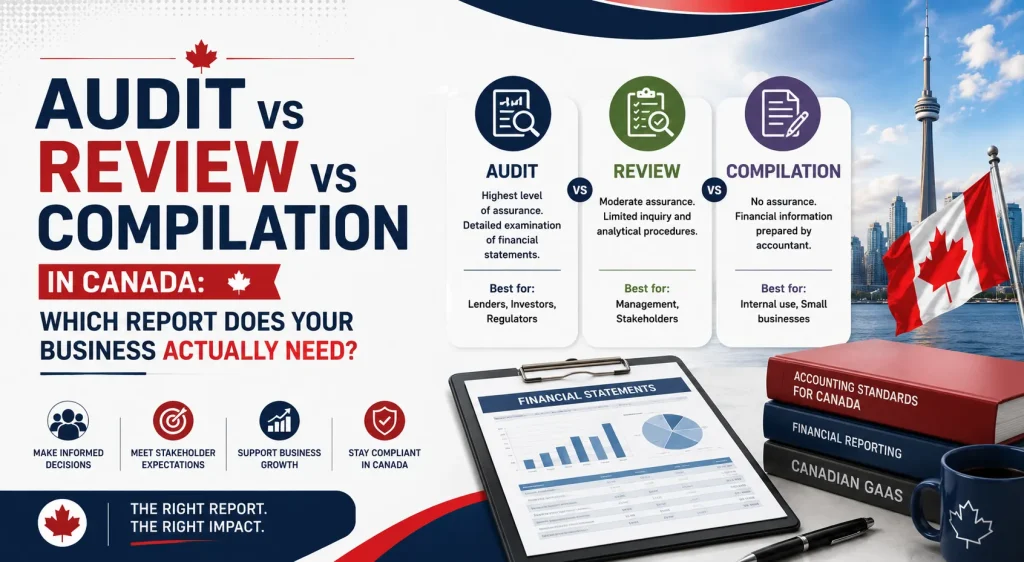




Whether you have ever submitted a financial statement, brought on a new investor, or perhaps simply attempted to file your year-end taxes in Canada, you have likely been asked about your financial statements and the sort of CPA engagement involved.
The three recurring terms are compilation, review, and audit. These cannot be substituted. They are all fundamentally different; each will require a different level of scrutiny, a different standard of professional work, and a different cost. The wrong choice could stall financing, annoy your stockholders, or bring you into technical default with your lender.
This guide explains what each engagement is, what the real meaning of the engagement is, what the job entails for your CPA, what it costs, and when Canadian businesses really need it. If you’re a small business owner who just wants to decode your first set of financials, a startup seeking investors, or a business owner frustrated by your bank’s requirements, this article will help clear up the confusion.
A note on terminology: The term “Notice to Reader” (NTR) is primarily being replaced by the new CPA Canada standards (CSRS 4200), which became effective on December 14, 2021. It is called a ‘Compilation Engagement Report’ in the new standard. But there are still many lenders, business owners, and even accountants who continue to speak the term “notice to reader” in everyday conversation. For the purposes of this guide, the terms are used interchangeably, as they are in the real world. |
What Is a Compilation (Notice to Reader)?
A compilation engagement, still commonly called a Notice to Reader, is the most basic level of financial statement preparation a CPA can provide. It is not an assurance engagement. That means the CPA is not verifying, checking, or vouching for the accuracy of the numbers.
So what does the CPA actually do in a compilation? They take the financial information you or your bookkeeper has prepared and organise it into properly formatted financial statements. They check for internal consistency and arithmetic accuracy and ensure the presentation follows an appropriate accounting framework. They do not independently verify any of the underlying figures with outside sources.
When Is a Compilation the Right Choice?
- Your financial statements are solely for internal use or for tax purposes.
- No outside party, whether bank, investor, or regulator, is asking for assurance.
- You are a privately owned business in which there are no other shareholders.
- You are just starting to work together with simple, easy-to-understand finances.
- You want the most cost-efficient and speediest method to create year-end financials.
A compilation has been used by many Canadian sole proprietors, small corporations, and family businesses for many years. So long as no one needs the extra comfort of a review or audit.
| Note: A CPA may issue a Compilation Engagement Report in CSRS 4200 (the current standard) while not being independent of the client, but any lack of independence should be disclosed in the report notes. This superseded the previous Notice to Reader format. |
To learn more about what this service entails, read our compilation engagement services overview and our explainer on what a compilation engagement is.
What Is a Review Engagement?
A review engagement is in the middle of the spectrum of assurance services. A review differs from a compilation in that it gives assurance, but not the assurance of an audit; only limited assurance.
During a review, the CPA performs analytical procedures and asks management questions to determine whether the financial statements appear reasonable in light of his or her knowledge of the business. Consider the application a check of authenticity, not a thorough verification. The CPA will use current-year figures relative to previous years, consider ratios and trends, and question inconsistencies.
The CPA can also review supporting documents like bank statements and other records and enquire about accounting practices, bookkeeping systems, financial plan policies, and fraud detection policies during the review. This review report does not provide an audit opinion. Rather, it offers negative assurance: “No reportable event, transaction or incident of which we have become aware might have materially affected the financial statements.”
In order to produce the review report, the CPA must be independent of the company and must comply with the Canadian Standard on Review Engagements (CSRE) 2400.
When Is a Review Engagement the Right Choice?
• Your bank or lender requires it under your credit facility or loan agreement.
• You have shareholders who are not involved in day-to-day management.
• You are seeking moderate external financing, and the lender has requested assurance.
• You want more confidence in your numbers without the full cost of an audit.
• You are preparing the business for eventual sale, succession, or future investment.
A review is often the right stepping stone for Canadian SMEs to grow. It adds meaningful credibility at a fraction of the cost of a full audit, and many banks accept reviewed statements for loans in the $250,000 to $1 million range.
What Is an Audit?
An audit is the most comprehensive and reliable financial review that a CPA can conduct. It affords reasonable assurance (but not absolute assurance) that the financial statements are free of material misstatement, whether caused by error or fraud.
Audit procedures are more extensive than inquiry and analysis. The auditor will review source documents, confirm with banks and customers, physically count items, conduct sample testing of transactions, and assess internal controls processes and effectiveness. The objective is to collect adequate and appropriate evidence to make an independent judgement.
A positive opinion is included in the audit report: “The financial statements present fairly, in all material respects, the financial position and results of the company. This is the most definitive level of credibility of financial reporting.
There can be both internal and external audits within a company. Internal audits conducted by internal teams or external auditors are shared with others within the company to identify improvement opportunities. External audit, checking the truthfulness of financial statements for external parties.
The Canadian Auditing Standards (CAS) regulate audits, and the CPA must be completely independent. In Canada, corporations with revenues over $250,000 and non-soliciting corporations with revenues over $1 million annually must have external audits under the Canada Business Corporations Act (CBCA).
When Is an Audit Required or Recommended?
- You need a significant amount of financing, usually more than $1 million, and the lender wants audited statements.
- You have an investor base of institutions or private equity investors.
- You are getting ready to sell or merge your business, and the prospective buyer will be doing diligence.
- You are working in a regulated sector like financial services, the public sector, or grant-funded organizations
- You are a public company (that complies with securities law) and are required to be audited.
- Your company has revenue and/or asset limits that exceed federal or provincial requirements.
- You do not have a unanimous annual waiver of the audit requirement from your shareholders under corporate law.
Another benefit of an audit is internal: along with the audit report, an auditor can prepare an audit management letter that outlines weaknesses in the internal control system and offers suggestions to strengthen it, which is very useful for businesses that want to professionalize their operations.
Comparison Table: Compilation vs Review vs Audit
| Feature | Compilation (NTR) | Review Engagement | Audit |
| Assurance Level | None | Limited (negative) | High (reasonable) |
| CPA Independence | Not required (must disclose) | Required | Required |
| Procedures | Format & compile data | Analytics & management inquiry | Document testing, confirmations, inspection |
| Report Wording | No opinion expressed | Nothing came to our attention…” | Presents fairly in all material respects.” |
| Governing Standard | CSRS 4200 | CSRE 2400 | Canadian Auditing Standards (CAS) |
| Relative Cost | $ (Lowest) | $$ (Moderate) | $$$ (Highest) |
| Typical Turnaround | Days | 1–3 weeks | Weeks to months |
| Common Use | Tax filing, internal use | Bank loans, minority shareholders | Investors, regulated industries, large loans |
| Detects Errors/Fraud? | No | May flag anomalies | High likelihood |
Key Differences Explained
1. Level of Assurance
This is the most essential one. An audit provides reasonable assurance, defined as a high degree of confidence that there are no material errors or misstatements. A review is a less comprehensive type of service that the CPA performs, in which the CPA does not draw any conclusion that anything came to his or her attention indicating a problem occurred, but there is more residual risk than with an audit. There is no guarantee of a compilation. The CPA does not comment on the accuracy of the numbers.
2. Procedures Performed
The most complex audit procedures are those that involve document inspection, third-party confirmations, transaction testing, and evaluation of internal control. The review is based on an analytical analysis and only a management inquiry into the figures; there is no independent verification of the figures by third parties. There are no verification procedures in compilation other than arranging and formatting the information that is provided.
3. Independence of the CPA
For reviews and audits, independence is required. This implies that the CPA must not be part of, nor have a conflict of interest in, the company that they are reporting for. Independence is not required (must be reported if not) for compilations using CSRS 4200.
4. Cost and Time
Compilations are the fastest and most affordable — often completed in days once books are finalised. Reviews take longer, typically one to three weeks, and cost roughly 50% more than a compilation, depending on complexity. Audits are the most time-intensive, often taking weeks to months, and fees are significantly higher. The added cost reflects the extensive evidence-gathering and documentation required.
5. What the Report Actually Says
Each report is written in a carefully distinct style. No assurance is provided in a compilation report. A review report contains negative assurance (Nothing came to our attention). An audit report is a positive opinion that may be issued (“in our opinion, the statements present fairly”). These words are not to be taken lightly by the lender or investor.
What Each Stakeholder Actually Wants
Banks and Lenders
Banks adjust the criteria they use for loans based on the loan size and the risk involved. If the loan amount is small, a lender-compiled notice to the reader may be accepted. For loans of around $250,000 or more, some of the Canadian lenders will require a minimum review engagement. When a commercial loan is larger (usually over $1 million), audited financial statements may be necessary.
After the closing of a loan, most lenders will have a covenant that calls for reviewed or audited statements to be made within 90 to 120 days of your fiscal year-end. Failure to comply with this covenant constitutes a “technical default”. Read the loan agreement closely: If the agreement states that you must submit a “review engagement” and you submit a compilation, you could be in violation even if the lender has not yet identified the compilation as a violation.
Investors and Equity Partners
More sophisticated equity investors, such as angel investors, venture capital funds, and private equity firms, tend to require audited financial statements before investing. At this early stage, reviewed statements are typically the bottom of the barrel. Giving the potential investor only a compilation means neither the company nor the numbers have been independently reviewed, which could raise questions about the quality of the numbers.
Regulators and Government Bodies
For standard applications of the private corporation tax, the CRA will not require audited or reviewed financial statements. There are, however, some federal and provincial grants that require CPA-reviewed or audited figures as part of the application. The threshold amount is a level of income that, under the law (Canada Not-for-Profit Corporations Act), may result in an audit or review of a non-profit organisation. Further details can be found on the Canada Revenue Agency (CRA) website.
Minority Shareholders
Canadian corporate laws mandate that corporations have an auditor and that shareholders receive an audited financial report, unless all shareholders consent to forgo the audit annually. If you have any minority shareholders who have not agreed to a unanimous audit waiver, they may have the right to require an audited report.
3 Mistakes Canadian Business Owners Make
Mistake 1: Assuming a Compilation Is Always Enough
Even when a business has matured to the point where lenders and/or investors demand more, many business owners still use a Notice to Reader. If your bank’s loan covenant calls for a review and you have been supplying a compilation, you could actually be in breach of the covenant without realising it. Review your financial reporting responsibilities each year, particularly after you’ve taken on new debt or new shareholders.
Mistake 2: Over-Investing in an Audit When a Review Will Do
A full audit is a waste of resources if your bankers and shareholders require only a review. An audit takes a lot of management time to answer the auditor’s questions, retrieve documentation, and conduct inventory counts. An audit is an unnecessary time and expense if it’s only needed for a review. Match your level of confidence with stakeholder needs.
Mistake 3: Not Planning Ahead for a Higher Assurance Level
Sixty per cent of businesses that suddenly find themselves needing to have their statements reviewed or audited due to a new investor appearing on the scene, a large loan being approved, or a threshold being crossed are scrambling. Changes from a compilation to a review or audit may necessitate changes to accounting policies and restatement of prior-year amounts. You should begin developing a reviewed and/or audited financial statement when it is not absolutely required.
When Should You Choose Each Report?
Choose a Compilation If:
- Your financial statements are solely for your own information and tax filing service purposes.
- You do not own any real estate with a mortgage, and you do not have any formal debts in your bank account.
- You are a sole trader or single-owner company.
- There are no external investors involved or non-managing shareholders.
- If you’re running the early stages of your business and cost is a top priority.
Choose a Review Engagement If:
- Your bank or lender requires it as part of your loan agreement
- You have shareholders who are not involved day-to-day in the business.
- You are in the process of preparing for financing in the near future
- The cost of an audit is too high – but you still need a professional “credibility check”
- You are planning to sell or pass on your business in the future
Choose an Audit If:
- You are looking for a large loan (usually $1 million or higher), and the lender wants audited statements
- You are an institutional investor, a private equity firm or in the process of going public.
- You have statutory audit requirements in your regulated industry.
- Your corporation generates a certain amount of revenue every year that exceeds the provincial thresholds for mandatory reporting.
- Not all of your shareholders have signed a unanimous audit waiver.
- You are selling your business, and the purchasers need financials that are due diligence-worthy.
Not Sure Which Financial Statement Engagement You Need?
Compilation, review, and audit engagements have different assurance levels, costs, and requirements. Get professional guidance to determine the right option for your business.
Why Most Canadian SMEs Choose Compilation Services
Most Canadian SMEs opt for compilation services because of the following reasons:
The truth is that for the majority of their lives, most small and medium-sized Canadian businesses conduct their business on compilation engagements, and they should. When there’s no one else who needs assurance, it’s not necessary to pay for a review or an audit.
Compilations are quick and inexpensive and, for most owner-managed companies without other shareholders and with little or no borrowed funds from the bank, are adequate. They enable you to generate well-structured and well-formatted financial statements for tax filing without an assurance engagement, but at a lower cost and with less time.
Usually when a business expands by obtaining a bank line of credit, adding a partner, or even considering expansion, there is a corresponding increase in need for assurance. The majority of Canadian accountants believe there is a logical sequence: early years’ compilations, as stakeholders increase; reviews; and only when size and scope necessitate it – audits.
| It isn’t the most impressive engagement; it’s the one that really meets your stakeholder needs, regulatory requirements and budget. Spending money on an assurance that you don’t need is just as wrong as spending it on an assurance that you do need. |
Frequently Asked Questions
Q1: Is a notice to reader the same as a compilation?
Yes, but with an important exception. A report accompanying a compiled set of financial statements used to be known as a “Notice to Reader”. The report is now called a Compilation Engagement Report, as per the new CPA Canada Standards (CSRS 4200) that apply to engagements commencing on or after December 14, 2021. The premise is the same: a CPA has compiled your financial information but does not guarantee anything. With a few exceptions, many accountants, banks, and business owners continue to use the term “notice to reader” in their everyday conversations, but when it comes down to it, the current standard doesn’t use that phrase anymore.
Q2: Is an audit mandatory in Canada?
No: The audit requirement is optional for private companies and can be voted to be waived annually by a unanimous vote of the shareholders, in accordance with the Canadian corporate statutes (both federal, under the CBCA, and most provincial counterparts). Under securities law, however, audits must be conducted for publicly traded companies and are required for certain regulated industries, corporations with revenues above a threshold, federally incorporated non-profits with revenue above a threshold and companies whose shareholders have not formally waived the requirement to have an audit.
Q3: When Do Canadian Businesses Need a Review or Audit Instead of a compilation?
Typical reasons for upgrading from a compilation to a review or audit are obtaining a bank loan, where the loan provider requires reviewed or audited statements as part of the conditions of the loan; having shareholders who are not actively involved in the management of the business; reaching a threshold on either revenue or assets that requires provincial reporting; attracting equity investors; preparing for a business sale or succession; or operating in a regulated industry with statutory reporting requirements. If any of these apply, discuss the engagement level with your CPA as early as possible.
Q4: Which Option Is the Most Cost-Efficient: Compilation, Review, or Audit?
The most economical option is the one that fits your true needs, not the lowest-priced option on the market. A compilation is the lowest-cost option, but if your bank requests a review and you do not provide a compilation, you will not have fulfilled your obligation and may be in default. A review is more costly than a compilation but less costly than an audit. An audit is the most costly, but if significant financing or investor due diligence depends on it, the expense is warranted by the access to capital it facilitates. Consider the cost and benefit of unlocking; the fee is not the only cost or benefit.