

 Australia
 USA
USA UK
UK Ireland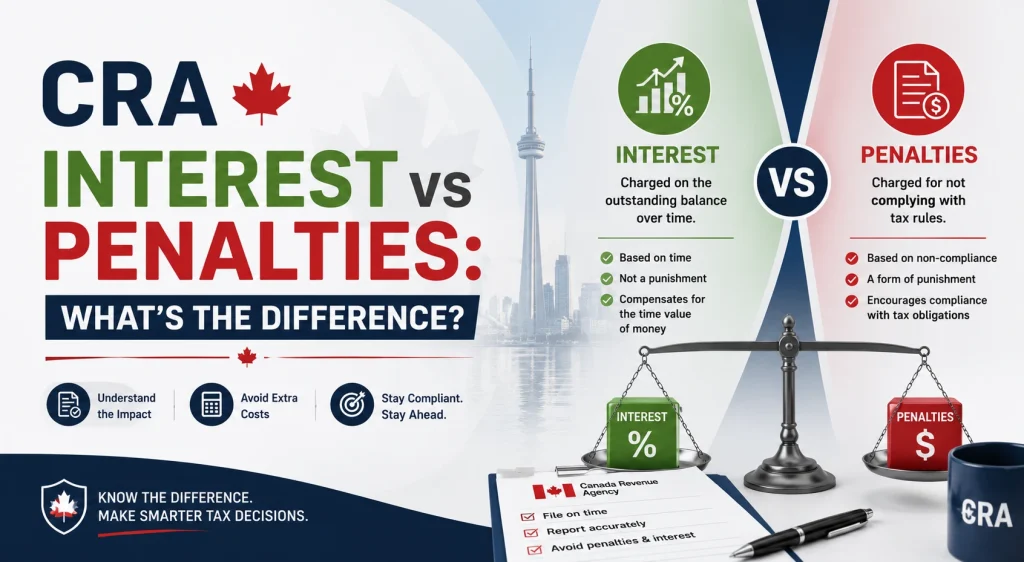




CRA Interest vs Penalties (Side-by-Side Comparison)
The table below gives you an at-a-glance view of how CRA interest vs penalties differ across every major dimension. Here is the difference between CRA interest and penalties:
| Factor | CRA Penalties | CRA Interest |
| What triggers it? | A specific rule violation (late filing, unreported income, etc.) | Any unpaid tax balance remaining after the due date |
| How is it charged? | One-time (or per occurrence) | Daily compounding: runs until the balance is zero |
| When does it start? | On the date the violation occurs | The day after your payment due date |
| Can it be waived? | Yes: via the Taxpayer Relief Program | Yes — via the Taxpayer Relief Programme. |
| Does CRA charge interest on it? | Yes: CRA charges interest on unpaid penalties | N/A (interest is the charge itself) |
| Is it based on a percentage? | Yes: typically a % of the tax owed or a flat amount | Yes: based on the CRA prescribed interest rate + 4% |
| Who does it apply to? | Individuals, businesses, corporations | Individuals, businesses, corporations |
Example — Same Situation, Different Charges:
Imagine you owe $5,000 in taxes for the 2024 tax year, and you file your return two months late without paying:
- Suppose that you are $5,000 overdue on your taxes for the 2024 tax year, and you file your return two months late, but you don’t pay your taxes:
- The Government imposes a late-filing penalty of 5% of the balance owing ($250), plus 1% per month thereafter.
- You also earn daily compound interest on the entire $5,000 from the actual due date.
- In a couple of months, that $5,000 debt could be $5,600–$5,800—and it continues to increase over time.
When Does the CRA Charge Penalties vs Interest?
It’s important to know when each charge (CRA interest vs penalties) will take effect so you can act appropriately at the right time.
When CRA Applies Penalties
When penalties are applied by the CRA.
The CRA doesn’t penalise arbitrarily. Each penalty corresponds to a specific tax provision that was not complied with. These are the most frequent triggers:
1. Late Filing Penalty: If you have a balance owing on your personal income tax return and the return is filed after April 30 (June 15 for self-employed persons), CRA will levy a late-filing penalty. One of the most frequently committed CRA late filing mistakes that Canadians make annually is (Source: CRA – Late Filing Penalty)
2. Repeated Late Filing Penalty: If you have been issued a CRA late filing penalty in any of the previous 3 years, CRA quadruples the late filing penalty. This is a significant level of escalation that most taxpayers would be surprised at.
3. Failure to Report Income: If you did not report the income, and it was $500 or more, the CRA may impose a penalty of 10% of the unreported amount (first time only). If it fails again in four years or less, then it goes up to 20%.
4. Gross Negligence Penalty: A penalty for gross negligence is up to 50% of the tax due on any understated income if the CRA concludes that the false tax statements or omissions were caused by gross negligence (Source: Income Tax Act, Section 163(2))
5. Third-Party Penalties: Tax preparation services, accountants or advisors who knowingly make a false statement on a client’s return may also be subject to CRA penalties (not individual taxpayers). (Source: CRA – Third-Party Civil Penalties)
6. Business and Payroll-Related Penalties Penalties for businesses that do not pay on time for payroll deductions (CPP, EI, and income tax) begin at 3% for up to 3 days late and increase to 10% for payroll deductions more than 7 days late.
When CRA Charges Interest
CRA interest is more automatic than penalties — it is not based on what you did; it is only based on whether you have an unpaid balance.
Interest Begins the Day After Your Payment Due Date
The payment date for most individual taxpayers is April 30th of the year. Interest will begin to accrue from the day after this date, May 1, even if you haven’t filed your tax return.
CRA Charges Interest On:
- Unpaid income tax balances
- Balances of unpaid income taxes
- Unpaid instalments (if you were required to pay tax by instalments and didn’t)
- Interest on penalties (yes, CRA charges interest on the penalties)
- Any benefits you were requested to pay back (such as CERB, CRB, OAS, or GST/HST credit)
Interest Compounds Daily
This is the segment of which most Canadians are unaware. CRA interest is not a fixed amount per year; it’s compounded daily at the prescribed interest rate plus four per cent. That equated to around 9–10% a year for 2024–2025, compounded daily. This accumulates over the course of months or years more quickly than people realise. The interest rates prescribed by CRA are shown below:
How CRA Calculates Interest vs Penalties
Penalty Calculation (Overview Only)
The amounts of penalties are determined in the Income Tax Act and vary according to the nature of the violation. The most common penalty, the late filing penalty, is the following:
- 5% of the balance due as of the due date
- Plus 1% late for each complete month, up to 12 months.
These rates are doubled for a repeated violation (you received a penalty in one of the three previous years).
- 10% upfront + 2% per month, up to 20 months
The penalties are 10% of the unreported income (20% if the offence occurs within 4 years of the first).
Please see the official CRA rates for detailed current rates. The complete rules are also available on Section 162 of the Income Tax Act.
Interest Calculation (Overview Only)
CRA calculates interest as:
Prescribed Rate + 4%, compounded daily on the unpaid balance (including penalties)
The prescribed interest rate is set quarterly by the federal government and is based on the average yield of 90-day Government of Canada treasury bills. This changes every three months, so your effective interest rate can shift throughout the year. (Source: CRA – Prescribed Interest Rates Table)
Key point: Interest on overdue taxes is not tax-deductible for individuals (though it may be for some business expenses related to earning income). (Source: CRA – Interest Deductibility)
Which Costs More: CRA Interest or Penalties?
Penalties are generally more costly in the short term, as they are a significant percentage of the balance due upfront for most taxpayers. However, with a debt that compounds interest over time (particularly if no payment is made for many months), the interest may exceed the penalty.
Example:
Assume your debt is $10,000 and you file two months late:
| Charge | After 2 months | After 12 months |
| Late-filing penalty | $700 (7%) | $1,700 (capped at 17%) |
| Interest (approx. 9% annual, compounded daily over 2 months) | ~$150 | ~$950 |
| Total extra cost | ~$850 | ~$2,650 |
As you can see, at 2 months, the penalty is almost 5X the interest. The gap has narrowed considerably over the past 12 months and continues to shrink with each passing month as the debt remains unpaid.
| Pro Tip: The moment you know you can’t pay your full balance, file your return on time anyway. Filing late and not paying triggers both the late-filing penalty and interest. Filing on time and not paying only triggers interest, which, while still costly, is significantly less than the penalty on top of it. |
Real Example: CRA Interest and Penalty Scenario
Situation: Let’s understand this with a real-life example. Meet Maria. She’s a freelance graphic designer who lives in Toronto, and she forgot to file her 2024 tax return until July 15, 2025 — about 2.5 months after the April 30 deadline. She owes $8,000 in taxes.
Here is what the CRA charged her:
Here is the Late-Filing Penalty:
- 5% of $8,000 = $400 (upfront)
- Plus 1% per month × 2 full months late = $160
- Total penalty = $560
CRA Interest (April 30 to July 15 = ~76 days):
- Prescribed rate + 4% = approximately 9% annually = ~0.0247% per day
- $8,000 × 0.0247% × 76 days = approximately $150
- Interest also applied on the $560 penalty from when it was assessed
Total CRA Add-On Cost: approximately $720–$740 on top of the original $8,000 balance.
What Maria should have done:
- Filed on time (even if you paid nothing) — this would have eliminated the $560 penalty
- Establish a CRA payment system to prevent further build-up of interest.
- Consulted with a tax expert before the deadline to make some tax planning ahead
Quick “What Will CRA Charge Me?”
Use this table to identify what charges apply to your situation quickly:
| Your Situation | Penalty | Interest | Both |
| Filed on time, paid in full | No | No | No |
| Filed on time, but paid late | No | Yes | No |
| Filed late, no balance owing | No | No | No |
| Filed late, balance owing | Yes | Yes | Yes |
| Missed instalment payment | Yes (Possibly) | Yes | Yes |
| Unreported income (first time) | Yes (10%) | Yes | Yes |
| Repeated unreported income | Yes (20%) | Yes | Yes |
| Gross negligence on return | Yes (up to 50%) | Yes | Yes |
| Example — The Most Expensive Scenario: A self-employed person who (1) failed to pay on time by April 30; (2) filed late; and (3) was previously late in one of the three years. The late-filing penalty (10% + 2%/month) is doubled for this person, and he has to pay interest on the amount that he still owes, including the unpaid penalty, a very expensive combination. |
When Should You Get Professional Help?
There are certain situations where having professional advice is strongly recommended to help with basic tax filing:
When to seek professional help:
- You have been sent a notice of assessment (NOA) by CRA with CRA penalties and/or unpaid interest that you do not understand.
- Self-employed and not sure about the instalment requirements
- You have several years of returns that have not been filed (may be a voluntary disclosure)
- You think a penalty was imposed unfairly and would like to seek a taxpayer relief programme.
- You have a big debt that you’re in need of assistance with negotiating a payment plan with the CRA.
- As a small business owner, you are facing penalties for payroll remittances.
A qualified tax professional, such as a CPA, tax accountant, or experienced bookkeeper, can negotiate relief, correct past mistakes, and create a plan that prevents additional penalties and interest from accruing.
Our tax return services team has helped individuals and small businesses with CRA issues across Canada before they become financial problems.
Facing CRA Interest or Tax Penalties?
Don’t let CRA charges continue to grow. Get professional assistance with unpaid tax balances, penalty notices, multiple unfiled returns, and taxpayer relief options.
Frequently Asked Questions
Q1: Is CRA Interest the Same as Penalties?
No. There are two separate charges. A penalty is a one-time charge for violating a tax requirement, such as failing to file a tax return or report income on time. Any unpaid balance (including unpaid penalties) will accrue interest, compounded daily. You can receive one without the other, but in many situations, you’ll receive both.
Q2: Does CRA Charge Interest on Penalties?
Yes. This is one of the most misunderstood aspects of CRA debt. After a penalty is issued and not paid, CRA charges daily compound interest on the penalty as it would on unpaid tax. This means your penalty won’t stay the same – it will keep increasing over time.
Q3: Does CRA Charge Both Interest and Penalties Together?
Yes – and this is the most frequent situation for those who file late and have a balance due. If you do, you will be charged a late filing penalty (which is a percentage of the amount due) and daily interest (which starts from the payment due date). The two charges run simultaneously and independently.
Q4: Can CRA Remove Both Interest and Penalties?
Yes, under certain conditions. Under CRA’s Taxpayer Relief Program, taxpayers may submit an application to have penalties and interest cancelled or waived when they were delayed due to extraordinary circumstances (serious illness, natural disaster, or CRA error), financial hardship, or other acceptable reasons. This is not a right/entitlement to apply for relief, but rather a procedural process that requires a completed application (Form RC4288) and supporting documents to be submitted.
Q5: How Do I Stop CRA Interest from Increasing?
To prevent accrual of interest on the CRA, the only way is to pay the full balance — principal tax due, penalties, and interest up to that time. Please contact CRA if you are unable to pay the full amount to arrange for a payment plan. If the principal is still growing, the simplest thing to do is stop it. If you think the interest is high for your circumstances, you may want to check into the Taxpayer Relief Program.
Q6: Which Is Worse: CRA Interest or Penalties?
Penalties are typically more detrimental in the short term, as they’re a high percentage of your balance charged in advance. But the daily interest on your debt can add up to a higher total than the penalty if you don’t pay your debt for a long period. The honest answer is that they are both expensive, but they are much more expensive when used in conjunction with each other. The most cost-effective option is to file even if not paid on time, as this avoids the late filing penalty, and to pay as soon as possible to reduce interest.